
Salads are often misunderstood.
For some people, they represent “diet food.”
For others, they feel unsatisfying or unnecessary.
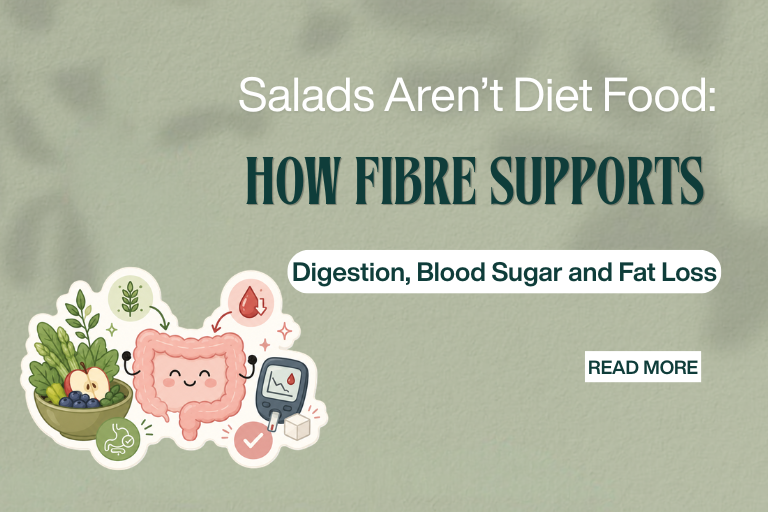
But when approached correctly, adding salads to your meals isn’t about restriction or weight loss hacks. It’s about supporting digestion, stabilising blood sugar, and making fat loss feel more sustainable.
Blood sugar spikes are one of the most overlooked reasons behind energy crashes, cravings, and difficulty with fat loss.
Adding a salad before or with your main meal helps:
The fibre and volume from vegetables act as a natural buffer. This is especially helpful if your meals include rice, roti, bread, or other carbohydrates.
Stable blood sugar means:
This makes salads for blood sugar balance an effective and simple habit.
Salads support fat loss not because they are “low calorie,” but because they improve how your body responds to meals.
When digestion and blood sugar are supported:
This is why adding salads for weight loss works best when they are additions, not replacements.
Fat loss becomes more sustainable when meals feel satisfying, nourishing, and balanced.
Vegetables add volume to meals without excessive energy density.
This helps you feel fuller, faster, and for longer. Not because you’re eating less, but because your body is receiving more signals of satiety.
Salads that include:
tend to keep you satisfied much longer than meals without vegetables.
One reason people struggle with salads is because they think of them as bland or incomplete.
A balanced salad should include:
This combination supports digestion, hormone health, and satiety.
Salads don’t need to be cold, boring, or restrictive to be effective.
For many people, gut health improves when fibre intake increases gradually.
Salads introduce a variety of plant compounds that support gut bacteria diversity. This can improve:
If you experience bloating initially, it often means your gut needs time to adapt. Starting with smaller portions and pairing salads with cooked foods helps ease the transition.
This makes salads and gut health a long-term support tool, not a quick fix.
Salads are not one-size-fits-all.
If you:
you may experience fatigue, cravings, or digestive discomfort.
The goal is balance, not extremes.
Salads should support your meals, not replace nourishment.
You don’t need elaborate recipes to see benefits.
Simple additions work best:
Consistency matters more than variety.
Adding salads to your meals is not about dieting.
It’s about supporting digestion, stabilising blood sugar, and making fat loss easier and more sustainable.
When salads are used as a supportive tool rather than a restrictive rule, they fit naturally into real life.
Health improves when meals feel balanced, not controlled.
And this is exactly what we do at Nourish by Karisma. We help you build balanced meals that support digestion, stabilise blood sugar, and make fat loss sustainable, without extremes.