
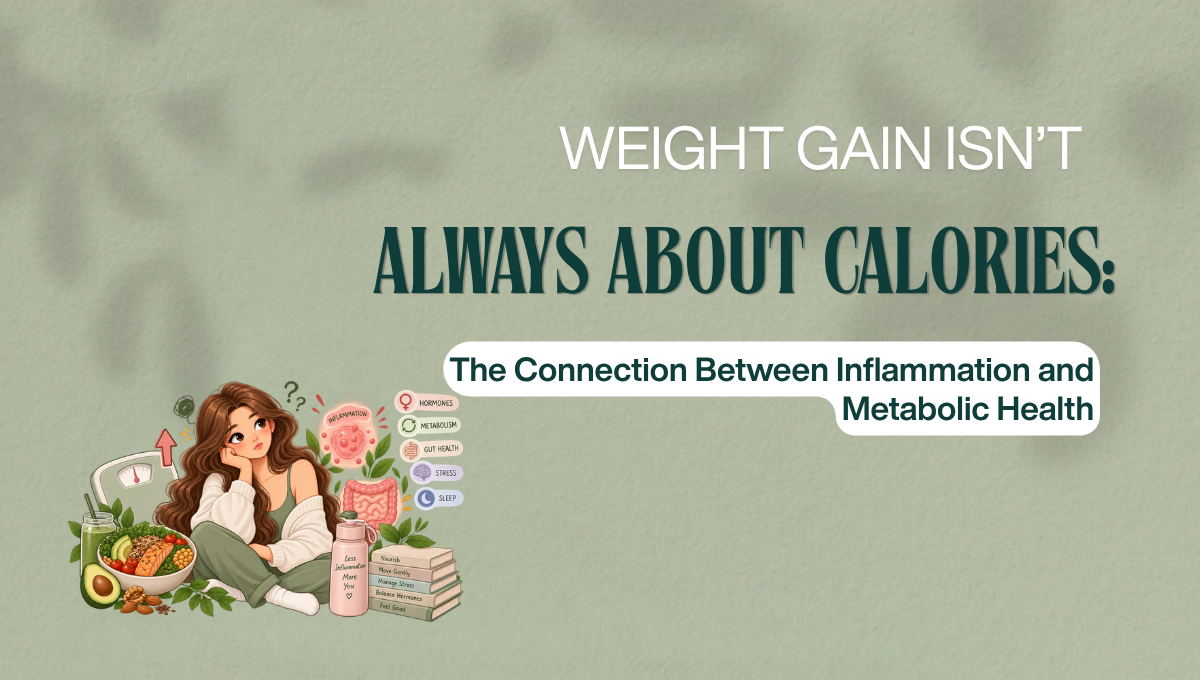
WEIGHT GAIN ISN’T ALWAYS ABOUT CALORIES: The Connection Between Inflammation and Metabolic Health
If you’re trying to lose weight, you’ve probably heard the same advice repeatedly: eat less, exercise more and create a calorie deficit.
Energy balance absolutely matters for changes in body weight. But weight regulation is more complex than calories alone.
Your sleep, activity, hormones, appetite, muscle mass, metabolic health and body composition can all influence how your body responds to changes in food intake and activity.
One factor that deserves more attention is chronic low-grade inflammation.
Inflammation isn’t automatically bad. It’s an essential part of your immune system’s response to injury and infection. The concern is when inflammatory activity becomes persistent rather than temporary.
And this is where inflammation and weight gain become closely connected.
What Is Chronic Inflammation?
Acute inflammation is your body’s short-term protective response. For example, if you injure yourself, the immune system activates processes that help protect and repair the affected tissue.
Chronic low-grade inflammation is different.
It involves a persistent, relatively subtle inflammatory state that can occur alongside metabolic dysfunction. Research has particularly linked inflammation in adipose tissue with obesity, insulin resistance and other metabolic complications.
Importantly, this isn’t simply a case of “inflammation causes weight gain.”
The relationship can work in both directions.
Excess adipose tissue can promote inflammatory signalling, while inflammation and metabolic dysfunction can make the body’s regulation of glucose and energy more complicated.
How Does Body Fat Connect With Inflammation?
We often think of body fat as simply stored energy.
But adipose tissue is metabolically active. It communicates with other parts of the body and produces signalling molecules that influence metabolism and immune function.
As adipose tissue expands, particularly with excess visceral fat, changes can occur within the tissue. These include changes in adipocytes and immune-cell activity that can contribute to chronic low-grade inflammation.
This matters because inflammatory signalling can interfere with insulin signalling.
Over time, this may contribute to insulin resistance, where cells become less responsive to insulin. Insulin resistance is closely associated with obesity and increased risk of type 2 diabetes.
So the relationship can look more like:
Excess adiposity → adipose tissue dysfunction → inflammation → impaired insulin signalling → metabolic dysfunction
But this isn’t a simple linear pathway, and not everyone with higher body weight has the same level of inflammation or metabolic risk.
Can Inflammation Make Weight Loss Harder?
Potentially, but this needs nuance.
Inflammation itself should not be used as an explanation for every weight-loss plateau.
However, the metabolic changes associated with chronic inflammation, excess adiposity and insulin resistance can influence the way the body handles glucose, fats and energy.
More importantly, several factors that are associated with chronic inflammation can also make healthy weight management harder:
- Poor sleep
- Low physical activity
- Excess visceral fat
- Diets high in highly processed foods
- Low fibre intake
- Chronic stress
- Excess energy intake
- Metabolic dysfunction
These factors often overlap rather than occurring individually.
That’s why looking for one “inflammation-causing food” usually misses the bigger picture.
Your Diet Matters, But Not in the Way Social Media Suggests
You don’t need a restrictive “anti-inflammatory diet” consisting of expensive powders, juices or exotic ingredients.
A more useful approach is to improve the overall dietary pattern.
Research suggests that dietary patterns higher in processed and energy-dense foods are associated with higher inflammatory markers, while dietary patterns rich in fibre, omega-3 fats and polyphenol-containing foods may support a healthier inflammatory profile. However, evidence is not perfectly consistent, and diet is only one part of the picture.
Think about what you can add rather than what you need to eliminate.
Add more:
Vegetables: spinach, carrots, broccoli, cauliflower, tomatoes and other colourful vegetables.
Fruits: berries when available, citrus fruits, guava, apples, pomegranate and other whole fruits.
Pulses: dal, chickpeas, rajma, black chana and other beans.
Whole grains: oats, brown rice, whole wheat, millets and other minimally processed grains.
Healthy fats: nuts, seeds, olive oil and other unsaturated fat sources.
Omega-3 sources: fatty fish for non-vegetarians, and foods such as flaxseed, chia seeds and walnuts for plant-based diets.
The goal isn’t to eat “perfectly.”
It’s to make nutrient-dense foods the foundation of your diet.
Don’t Forget Protein
If you’re trying to improve body composition, protein deserves special attention.
Adequate protein can help support muscle maintenance, particularly during weight loss. Pairing protein with fibre-rich foods can also make meals more satisfying.
For an Indian diet, that could mean:
Dal + rice + vegetables + curd
Rajma + rice + salad
Paneer/tofu + roti + sabzi
Eggs + whole-grain toast + vegetables
Chickpea salad + curd
This is much more useful than simply searching for a single “anti-inflammatory food.”
Movement Is Part of the Picture Too
Exercise isn’t only about burning calories.
Regular physical activity supports metabolic health and can be part of a broader strategy for managing body composition and inflammation.
You don’t need to start with an intense workout routine.
Walking, resistance training, cycling, swimming and other activities that you enjoy can all contribute to an active lifestyle.
For someone focused on fat loss, strength training is particularly valuable for maintaining muscle while reducing body fat.
The goal is to build a body that is metabolically healthy, not simply to make the number on the scale smaller.
Sleep and Stress Matter More Than You Think
Nutrition often gets all the attention, but sleep and stress are part of the same metabolic picture.
Poor sleep can affect appetite, food choices, energy and physical activity. Chronic stress can also influence eating behaviour and make consistency more difficult.
So if you’re eating well but constantly exhausted, sleeping poorly and relying on highly restrictive dieting to compensate, the solution may not be another diet.
It may be time to look at the whole lifestyle.
What About “Inflammation Weight”?
Be careful with this phrase.
Social media often makes it sound as though you can gain several kilograms of “inflammation weight” and then lose it through a detox or anti-inflammatory drink.
That’s an oversimplification.
Short-term changes on the scale can come from water, glycogen, sodium, food volume and bowel contents, while changes in body fat occur over a longer period.
Inflammation is a biological process, not a separate type of fat that can simply be “flushed out.”
The Takeaway
The connection between inflammation and weight gain is real, but it’s more complicated than “inflammation makes you fat.”
Excess adiposity can promote chronic low-grade inflammation, and inflammation within adipose tissue can contribute to insulin resistance and metabolic dysfunction.
Instead of chasing detoxes or eliminating entire food groups, focus on the fundamentals:
Eat more whole and minimally processed foods.
Prioritise protein and fibre.
Include healthy fats and omega-3 sources.
Move your body regularly.
Build and maintain muscle.
Prioritise quality sleep.
Manage chronic stress.
Aim for sustainable changes rather than extreme restriction.
And remember: you don’t need to “fight inflammation” with a miracle food.
You need a lifestyle that supports metabolic health consistently.