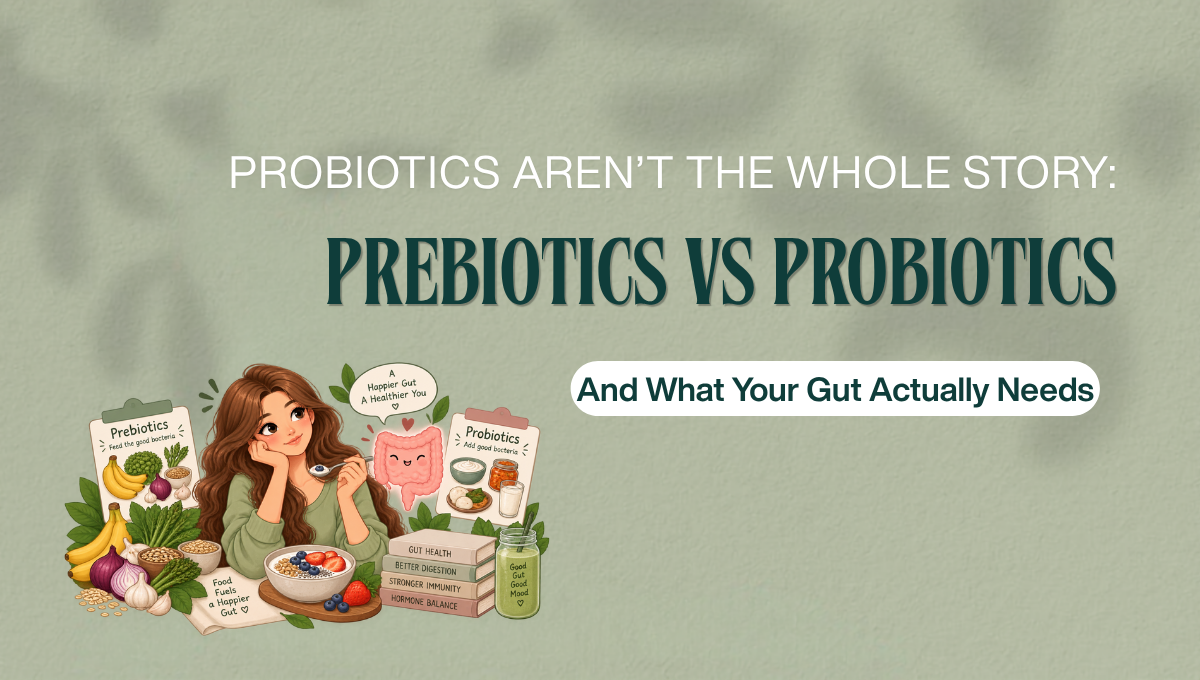
PROBIOTICS AREN’T THE WHOLE STORY: Prebiotics vs Probiotics and What Your Gut Actually Needs
If you’ve ever walked into a supplement store looking for something to improve your gut health, you’ve probably seen the words probiotics and prebiotics everywhere.
They sound almost identical, but they aren’t the same thing.
And here’s where nutrition gets interesting: your gut doesn’t simply need you to “add good bacteria.” The food you eat also influences the environment those microorganisms live in.
So, what is the difference between prebiotics and probiotics, and do you actually need both?
First, What Are Probiotics?
Probiotics are live microorganisms that provide a health benefit when consumed in adequate amounts. They include certain bacteria and yeasts and can be found in some fermented foods and dietary supplements.
Different probiotics contain different microorganisms, and their effects can vary depending on the specific strain, dose and health condition being studied.
This is important because “probiotic” isn’t a synonym for “anything fermented.”
A fermented food may contain microorganisms without meeting the scientific definition of a probiotic or having demonstrated health benefits from those specific microorganisms.
Food sources can include:
- Live-culture yoghurt
- Some fermented dairy products
- Certain fermented foods with live microorganisms
But always check the product and preparation method. Not every fermented food contains live microorganisms at the time you eat it.
So, What Are Prebiotics?
Here’s the part many people miss.
Prebiotics aren’t bacteria.
A prebiotic is a substrate that is selectively used by microorganisms in a way that provides a health benefit. Many prebiotics are types of fermentable carbohydrates, although not all dietary fibre is technically prebiotic.
Think of it this way:
Probiotics = beneficial live microorganisms
Prebiotics = substances that beneficial microorganisms can use
Your diet can therefore influence the gut microbiome not only by supplying microorganisms, but also by supplying the types of food components that support microbial activity.
Where Do You Get Prebiotics?
You don’t necessarily need a specialised prebiotic supplement.
Many everyday plant foods contain fibres or carbohydrates that can be utilised by gut microorganisms.
Examples include:
Garlic
Onions
Asparagus
Legumes
Whole grains
Certain fruits and vegetables
Foods containing resistant starch
Specific prebiotic compounds include substances such as inulin, fructooligosaccharides (FOS), galactooligosaccharides (GOS) and resistant starch.
This is one reason dietary variety matters.
Instead of eating the exact same “gut health” food every day, aim to include different plant foods across the week.
Do You Need Both?
For most healthy people, there’s no universal rule saying you must take a probiotic supplement and a prebiotic supplement.
In fact, your first step doesn’t need to be supplements at all.
A more practical approach is to build a diet that contains fibre-rich plant foods regularly and, if suitable for you, include fermented foods that provide live microorganisms.
That gives your gut microbiome exposure to a variety of dietary components while avoiding the assumption that everyone needs the same probiotic product.
Research on probiotics is also highly strain-specific. A probiotic that has evidence for one condition doesn’t automatically have the same effect for another.
The Indian Diet Already Has Gut-Friendly Building Blocks
You don’t need an expensive “gut reset.”
Look at your everyday meals.
Dal + vegetables + roti
Rajma + rice + salad
Chana + vegetables
Oats + fruit + seeds
Curd + fruit + nuts
These meals can provide fibre, plant compounds and other nutrients that support a diverse diet.
If you tolerate dairy, curd with live cultures can be a convenient fermented food option. Just remember that the presence of fermentation alone doesn’t guarantee a food meets the scientific definition of a probiotic.
What About Gut Health Supplements?
This is where you should be careful.
A product labelled “50 billion probiotics” may sound automatically better than one containing fewer organisms.
But more isn’t necessarily better.
Probiotics are identified by their genus, species and strain, and different strains can have different effects. There are also no universal recommendations that every healthy person should take a probiotic supplement.
If you’re considering a supplement, look beyond the marketing:
- What strain does it contain?
- What is the intended benefit?
- Is there evidence for that specific strain and condition?
- What dose was studied?
- How should it be stored?
- Is it appropriate for you?
This is particularly important if you have an underlying medical condition or a weakened immune system.
One More Important Point: Increase Fibre Gradually
If your current diet is low in fibre, suddenly adding large amounts of beans, seeds, whole grains and other high-fibre foods can cause bloating, gas or abdominal discomfort.
Instead, increase fibre gradually and make sure you’re drinking enough fluids.
For example, don’t go from almost no legumes to several large servings every day overnight.
Start with a manageable change:
Add one serving of dal.
Add a fruit.
Include vegetables at lunch and dinner.
Swap some refined grains for whole grains.
Then build from there.
What Your Gut Actually Needs
Gut health isn’t about finding one magical probiotic capsule or drinking one fermented beverage every morning.
It’s much broader.
Your gut microbiome interacts with your diet, lifestyle and overall health, and researchers are still learning exactly how different dietary patterns and microorganisms influence health.
So instead of asking:
“Which probiotic should I buy?”
Start with:
“How diverse is my diet?”
Are you eating enough fibre?
Are you regularly eating vegetables, fruits, pulses, whole grains, nuts and seeds?
Do you tolerate fermented foods?
Are you getting enough protein?
Are you sleeping well and staying physically active?
These questions provide a much stronger foundation for gut health.
The Takeaway
Prebiotics and probiotics aren’t competing concepts. They’re different.
Probiotics are specific live microorganisms that can provide health benefits when consumed in adequate amounts.
Prebiotics are substrates selectively used by microorganisms in a way that provides a health benefit.
And while they can work within the same overall gut-health strategy, you don’t automatically need a supplement containing both.
For most people, start with the basics:
Eat more dietary variety.
Include fibre-rich plant foods regularly.
Add fermented foods if they suit you.
Increase fibre gradually.
Choose supplements based on evidence and individual need, not marketing claims.
Your gut doesn’t need the trendiest product.